


- Home
- Our Team
- Services
- Healthcare Legal Services
- Accountable Care Organizations and Other Providers of Health Services
- Telehealth and Virtual Care
- Digital Health Platforms and Tools
- Clinical Supervision and Management
- Medical Technology and Devices
- Wellness and Health Improvement Programs
- Licensing and Credentialing
- AI in Healthcare
- HIPAA Compliance
- Regulatory Requirements for Health Plans
- Healthcare Advisory Services
- Business and Corporate Law
- General Counsel Services
- Employment Law
- Immigration and Employer Sponsorship
- Healthcare Legal Services
- Media
- Blog
- Contact
New York City Business Law Attorneys for Medical Devices
Lawyers Helping Health Organizations and Manufacturers Nationwide With Technology-Related Issues
In modern healthcare, different types of technologies are used in the diagnosis, treatment, monitoring, and management of medical conditions. While these technologies provide many benefits, they may also introduce risks for businesses and organizations that use them.
Healthcare organizations will need to meet all applicable regulatory requirements when using medical technology. They will also need to protect themselves against liability. Failure to address these issues could lead to multiple types of penalties or other issues that could result in financial losses.
A business that does not comply with regulations when using medical technology may face fines and other penalties. It may also face liability for data breaches or injuries caused by devices that did not function properly or were used incorrectly. These issues could threaten the future of a business, limiting its ability to grow or even resulting in a total shutdown.
Medical technology companies will also need to address regulatory issues, protect their intellectual property, and manage relationships with healthcare providers. Failure to address these issues correctly could lead to violations, liability, or other concerns that may result in significant losses.
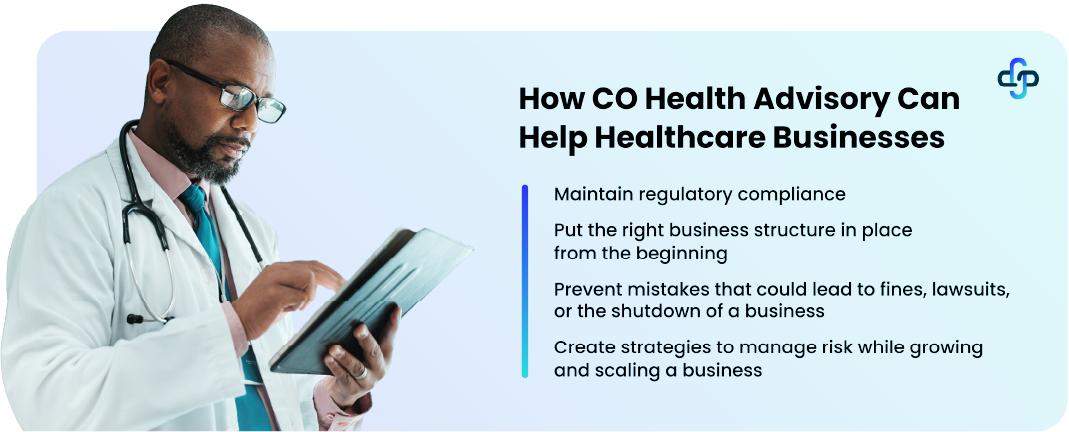
Addressing legal issues related to medical technology correctly will often require counsel from an attorney who has experience in the healthcare sector. At CO Health Advisory, we understand the regulations that apply to medical devices and other issues that can affect the success of healthcare businesses. We can help businesses avoid costly mistakes while making sure they will be prepared for future growth and success.
To learn more about how we can help healthcare organizations address concerns related to medical technology and devices, contact us and arrange a strategy call.
Regulatory Compliance for Medical Device Manufacturers
Medical device companies are required to comply with federal regulations that are administered by the Food and Drug Administration. Manufacturers will need to address concerns related to design, production, and quality assurance. Adverse event reporting is also required, including medical device tracking for certain high-risk devices.
Our attorneys work with medical device companies to maintain regulatory compliance. We can provide guidance on FDA submission strategies. We work with companies to develop documentation, establish compliance procedures, and prepare for FDA inspections. When companies face warning letters, inspections, or other regulatory actions, we can provide representation and work to resolve these concerns effectively.
Intellectual Property Protection
Medical device companies invest substantial resources in research and development. Patents, trademarks, trade secrets, and copyrights can protect innovations and help companies maintain a competitive advantage.
Medical device patents must meet specific requirements. Companies may need to address validity challenges and consider the timing of patent filings based on timelines for product development and public disclosures.
Trade secret protections can serve as an alternative or complement to patents. Information that provides economic value to a company may be subject to reasonable secrecy measures. Manufacturing processes, customer lists, and other confidential business information may be protected as trade secrets.
Trademarks can protect the identities of brands, including company names, product names, and logos. Strong trademarks can help medical device companies build recognition and differentiate their products in competitive markets.
Our lawyers provide guidance for medical device companies on the best strategies for protecting their intellectual property. We can assist with patent applications, trademark registration, trade secret protection, and intellectual property licensing. We work with clients to develop comprehensive intellectual property portfolios that will support their business objectives throughout the life cycles of medical products.
Vendor Contracts for Healthcare Organizations
Healthcare organizations that use medical devices will need to establish contractual relationships with device manufacturers, distributors, and service providers. These agreements may address equipment acquisition, maintenance, supplies, training, and support services. The terms of these contracts can affect the total cost of ownership and the risks that organizations may face.
Medical device purchase agreements should clearly define equipment specifications, delivery schedules, installation, acceptance testing, and warranties. Healthcare organizations will need to ensure that devices meet regulatory requirements, are approved for their intended uses, and come with adequate documentation. Payment terms, including deposits, milestone payments, and final payment conditions, should be fully understood.
Warranty provisions are key parts of vendor contracts. An organization will need to understand what defects are covered, the duration of warranty protections, and the steps that will be taken when devices fail to perform as expected.
Service and maintenance agreements can ensure that ongoing support will be provided. These contracts should address the response times for service calls, schedules for preventive maintenance, and other related concerns. For critical devices that may affect patient safety or essential hospital operations, an organization may need to make sure response times will be guaranteed or ensure that backup equipment will be available.
Our attorneys work with healthcare organizations to ensure that they will be protected by medical device vendor contracts. We can review purchase agreements and service contracts to identify potential issues and negotiate favorable terms. We will help clients understand their rights and obligations, ensure that they have adequate warranty protection, and establish service level expectations.
Privacy and Security for Connected Devices
Many modern medical devices include connectivity features that enable remote monitoring, data transmission, software updates, and integration with electronic health record systems. When using connected devices, organizations will need to address privacy and security considerations.
The Health Insurance Portability and Accountability Act (HIPAA) establishes requirements for protecting health information that will apply when medical devices generate, transmit, or store protected health information. Device manufacturers that access patient data through their products will need to implement safeguards to protect sensitive health information.
Cybersecurity is a critical concern for connected medical devices. Manufacturers may need to implement security controls such as authentication systems, encryption, and access controls. They will also need to establish procedures for identifying and addressing cybersecurity issues discovered after a product's release.
Healthcare organizations will need to evaluate the cybersecurity features of medical devices and implement the proper controls and monitoring to protect against unauthorized access. They should also establish procedures for applying security patches and updates while maintaining regulatory compliance.
CO Health Advisory works with healthcare organizations and medical device companies to address privacy and security concerns related to connected devices. We help clients understand their legal requirements, and we work with them to develop security policies, implement data protection measures, and respond to security incidents.
Product Life Cycle Strategies
Medical device companies will need to address evolving legal concerns and business considerations throughout the life cycles of products, from the initial concept development through the eventual discontinuation of products. With strategic legal counsel during each stage of the life cycle, a company can address potential challenges and take advantage of opportunities.
During the development phase, companies will need to consider regulatory strategies, intellectual property protections, funding arrangements, and collaborative relationships with research institutions or development partners. Addressing regulatory requirements early can help avoid the need for costly redesigns during later development stages.
The commercialization phase may involve submissions to regulatory authorities, manufacturing and distribution, pricing strategies, and promotional activities. Medical device companies will need to ensure that their promotional materials comply with FDA regulations and that they do not make unsupported claims.
Post-market activities may include monitoring for adverse events, handling complaints, taking corrective actions, and making product improvements. Companies will need to balance the benefits of product enhancements against potential regulatory issues, including obtaining clearance or approval for modifications. The decision to discontinue a product may involve concerns such as customer notifications, service and repair obligations, and potential liability.
Our lawyers provide strategic counsel to medical device companies throughout product life cycles. We help clients anticipate legal issues, develop strategies for addressing challenges, and make sure they can capitalize on opportunities.
Contact Our New York City Medical Device and Technology Lawyers
For organizations that use medical devices when providing care to patients and companies that develop medical technologies, the lawyers at CO Health Advisory can provide effective legal counsel and strategic advice. We can address regulatory requirements, intellectual property protections, legal agreements, and other issues that may affect our clients. Contact our New York medical technology attorneys to arrange a consultation.
Clients We've Worked With

Ready to Get Started?
Contact us today
 The use of the Internet or this form for communication with the firm or any individual member of the firm does not establish an attorney-client relationship. Confidential or time-sensitive information should not be sent through this form.
I have read and understand the Disclaimer and Privacy Policy.

From our office in New York City, we provide representation for businesses in the surrounding area, including Manhattan, Brooklyn, Queens, The Bronx, Yonkers, Jersey City, Hoboken, and Newark. We also work with businesses throughout the United States, including in Boston, Philadelphia, Baltimore, Atlanta, Detroit, Chicago, Houston, Dallas, Denver, Phoenix, Seattle, San Francisco, and Los Angeles.
17 State Street, Fl 40, Suite 4000, New York, NY 10004
212-739-0611
Hours: Monday - Friday, 9am - 5pm EST